
Inner Three Model (ITM)
Developed by Sofia Papoutsi
Introductory Note
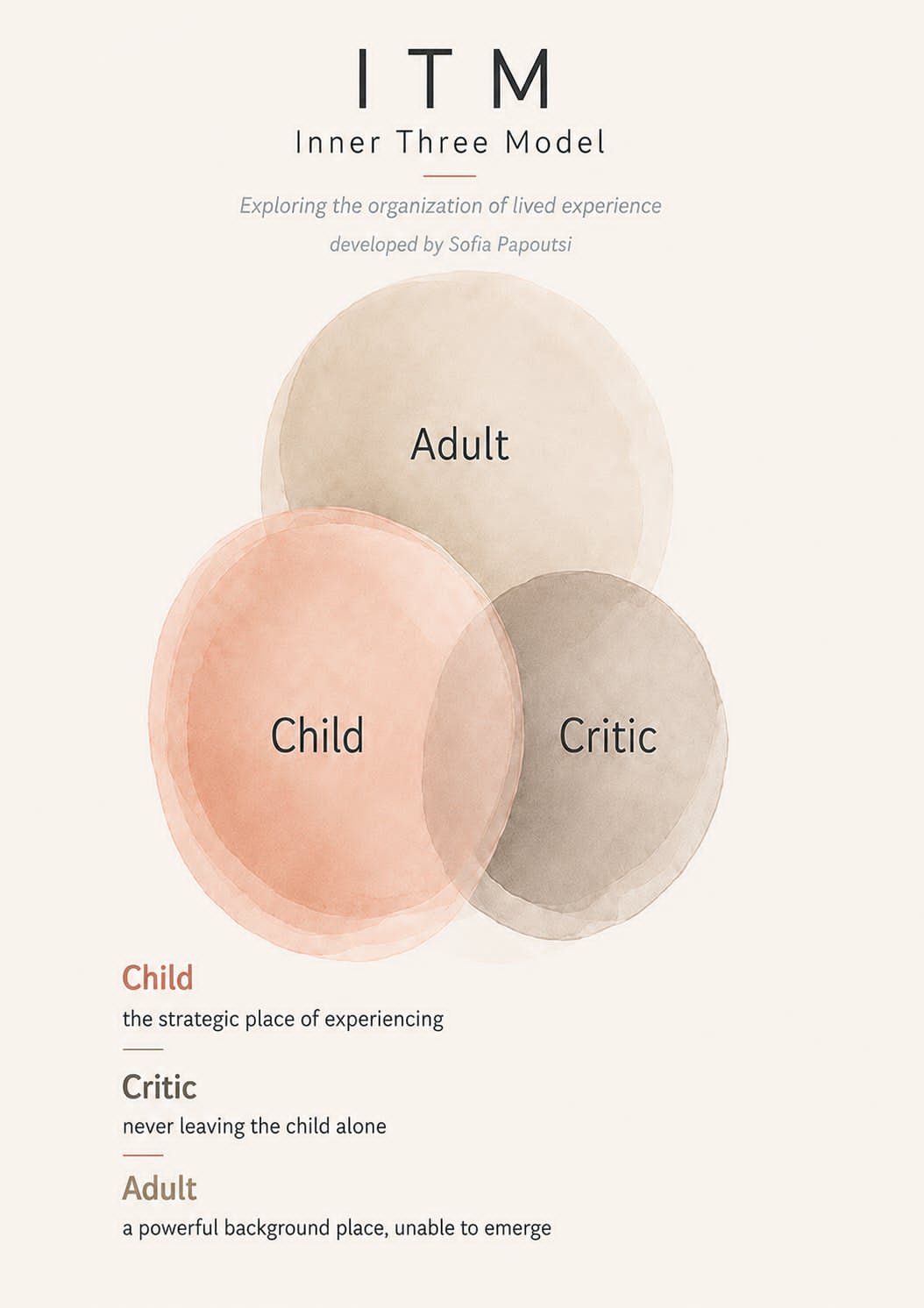
ITM (Inner Three Model) is an experiential framework exploring how lived experience may become organized around three experiential places: the Child, the Critic, and the Adult.
Emerging through clinical practice, experiential observation, and Person-Centred & Focusing-oriented psychotherapy, the model attempts to describe recurring inner movements and organizational patterns that appear across different human situations and therapeutic processes.
Rather than presenting fixed personality structures, ITM approaches these places as dynamic experiential organizations that continuously interact, shift, and reorganize within lived experience.
Philosophical & Experiential Background
Within the broader experiential and focusing-oriented tradition, human experience is approached not as static content, but as an ongoing living process continuously forming and reorganizing itself in interaction with life situations.
From this perspective, the self is understood not as a fixed structure, but as an unfolding experiential process through which meaning, perception, relationships, and ways of being gradually emerge.
Drawing from this process-oriented understanding of lived experience, ITM explores how experience may become organized through different inner experiential places.
Experiential and focusing-oriented perspectives do not approach lived experience as always unified or fixed. At times, experience may become internally divided and organized through different experiential places, while, at a given moment, experiencing may become more strongly organized through one experiential place than through others.
At the same time, divided experiencing may also emerge within the same experiential place. In this sense, experiential places are not understood as rigid or internally uniform structures, but as dynamic experiential worlds, each carrying its own modes of organization, qualities of being, and lived senses of reality.
The Child Place
The Child Place in ITM is not understood simply as the “inner child,” but as a leading experiential place through which experience becomes organized and lived.
Within the ITM framework, the Child Place often appears in the foreground of experience, shaping perception, emotional meaning, and relational life.
Over time, the Child Place may gradually become the familiar experiential position through which life is primarily perceived and lived.
The Critic Place
Operating in close proximity to the Child Place, the Critic continuously monitors, interprets, corrects, and intervenes in lived experience.
Although the Child and Critic places may appear internally opposed, they often function through a deeply interdependent dynamic in which each reinforces and sustains the other.
Within this organization, separation may feel threatening, as the two places often experience themselves as unable to exist independently.
The Adult Place
Within the ITM framework, the Adult Place does not emerge primarily as control, rationality, or self-management, but as an experiential place through which life may be carried forward and lived differently.
The Adult Place may carry qualities of openness, groundedness, creativity, presence, trust, and emotional steadiness, yet often remains in the background of lived organization as experience repeatedly returns to the familiarity of the Child Place.
Ongoing Development
The material presented on this page offers only an introductory view into the ITM framework. Additional experiential, relational, and theoretical dimensions of the model are not yet fully presented here.
Alongside its theoretical and experiential foundations, ITM also includes an emerging therapeutic methodology grounded in experiential and process-oriented practice.
Workshops & Contact
Workshops and experiential explorations based on the ITM framework are currently being developed and facilitated internationally.
If you are interested in ITM, future workshops, or experiential collaboration and dialogue, feel free to get in touch.
Selected References
Ann Weiser Cornell & Barbara McGavin — Untangling: A Guide to Moving Beyond the Inner Critic
Eugene Gendlin — A Process Model
Eugene Gendlin — Focusing-Oriented Psychotherapy
Campbell Purton — Person-Centred Therapy: The Focusing-Oriented Approach